Review the assessment
The lawyer sees the assessment of a specific claim and can check it against the relevant passage and source material.
Human in the loop
AR3S assesses the opinion claim by claim. Before those assessments are combined into higher-level conclusions, the lawyer can review, correct or override each one.
AR3S first breaks the opinion into individual claims and assesses each one. The lawyer can review and change those assessments. The next stages use the corrected version.
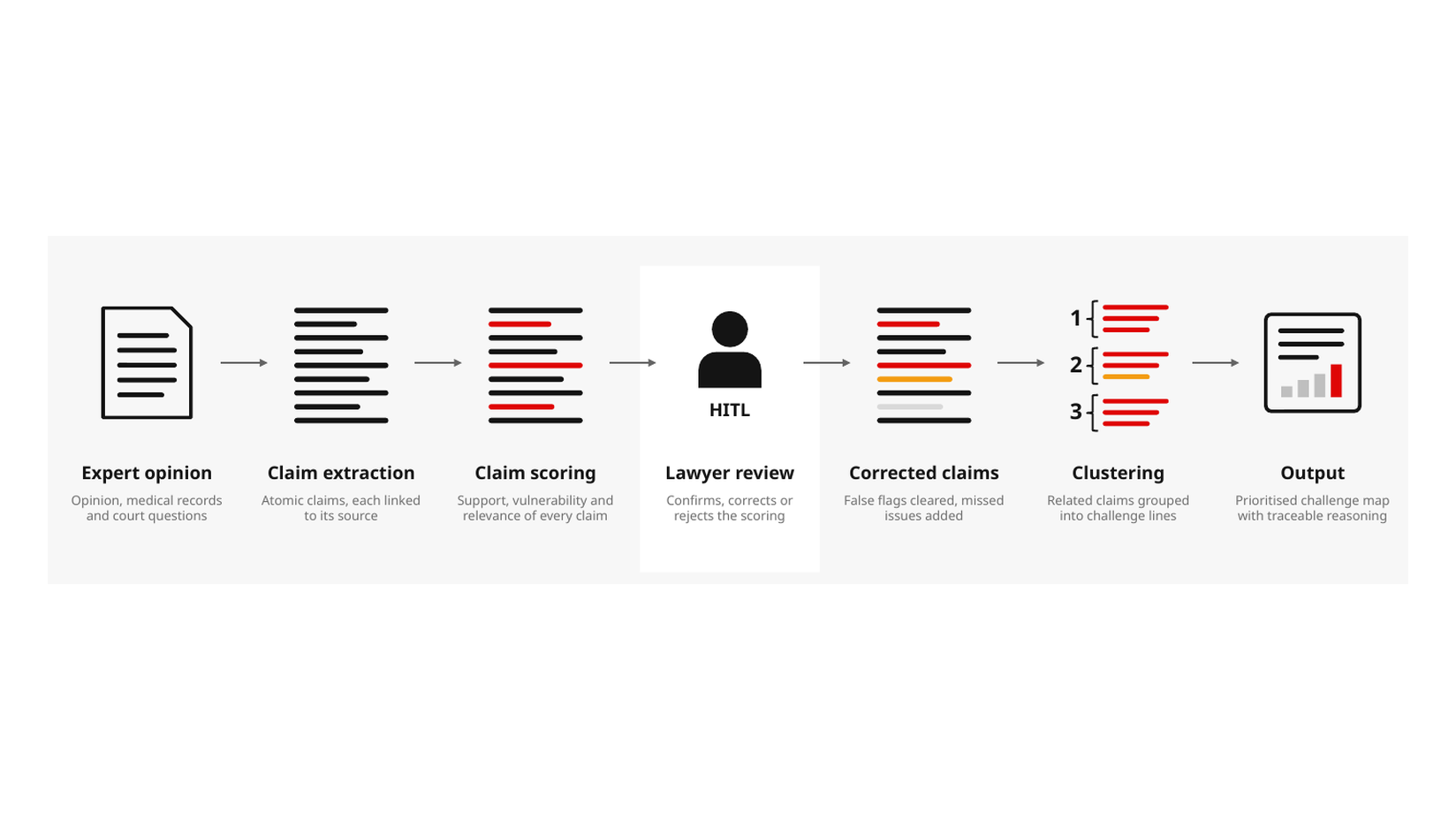
The lawyer can change the assessment of an individual claim before AR3S combines it with others and uses it in later stages.
The lawyer sees the assessment of a specific claim and can check it against the relevant passage and source material.
The lawyer can correct an assessment or clear a false flag.
Clustering, prioritisation and the final output use assessments that include the lawyer’s corrections.
The original AR3S assessment remains visible after a correction. The two versions can be compared, making it clear how the change affected later stages.
After a correction, the original AR3S assessment is still available for comparison.
Later analysis uses the version that includes the lawyer’s corrections.
Sources, original assessments and user corrections remain separate, so the path to the final output can be checked.
Demo · Pilots
The demo shows a sample analysis and litigation strategy. HITL will be refined during pilots on real law-firm cases.